The Rise of Cognitive Debt!
AI accelerates software development, but it creates cognitive debt: systems that function yet remain largely misunderstood, posing significant risks for teams.

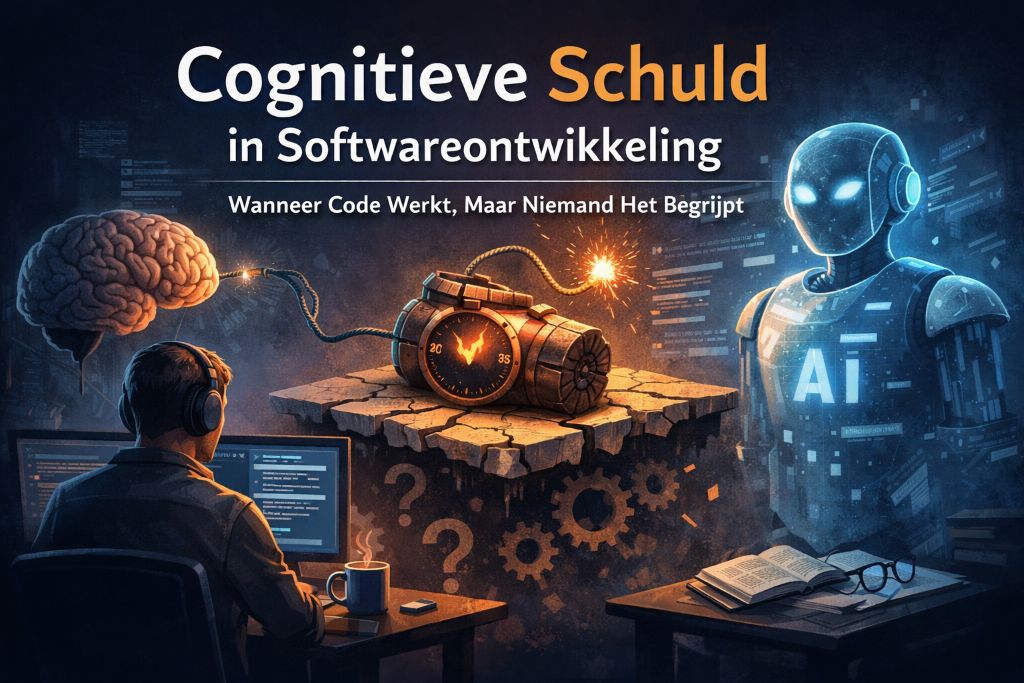
The Invisible Crisis in Software Development: The Rise of Cognitive Debt
AI can generate code at lightning speed these days. Tools like GPT models and modern AI assistants can produce complete functions, API integrations, or even entire applications in seconds. For many teams, it feels like software development has suddenly shifted into a higher gear.
But while everyone celebrates productivity, a more important question rarely gets asked:
What are we actually losing in the process?
When developers use AI as a kind of magic black box—feeding in a problem and immediately accepting the generated code—they create a new kind of risk. Not the familiar technical debt, but something more fundamental:
Cognitive debt.
It’s a kind of debt that doesn’t live in the code, but in the team’s head.
What Is Cognitive Debt?
Cognitive debt builds up when software works, but the team no longer truly understands the system. The code may be syntactically correct, well structured, and fully functional—yet the shared mental model of how the system behaves is gone.
That may sound abstract, but in practice it simply means:
No one can clearly explain why the code works.
Software development isn’t just about writing code. It’s about understanding: why architectural decisions are made, how components communicate, and where the risks are hiding.
When AI makes a large part of those decisions, but the team doesn’t internalize them, cognitive debt grows.
Technical Debt vs Cognitive Debt
We all know technical debt. It happens when we build quick solutions that make future maintenance harder—poor abstractions, duplicated code, temporary hacks.
Cognitive debt is subtler, but potentially more dangerous.
- Technical debt is visible. Linters, code reviews, and CI/CD pipelines flag issues.
- Cognitive debt is invisible. There’s no tool that measures whether a team still understands the code.
- Technical debt lives in the code.
- Cognitive debt lives in the lack of understanding.
Ironically, code with a lot of cognitive debt can look perfect. AI often produces clean, consistent, well-structured code.
The problem isn’t syntax quality. The problem is that no one truly owns the design anymore.
The Productivity Illusion
AI-assisted development feels extremely productive. Features ship faster, pull requests come in rapidly, and sprint metrics look impressive.
But that speed can be a dangerous illusion.
Teams appear more productive, while in reality they become increasingly dependent on AI to understand their own systems.
This usually becomes visible only when a serious incident happens.
A critical system breaks. The logs point to a complex piece of code generated months earlier with AI. No one on the team knows exactly how it works. What should have been an hour fix turns into days of debugging.
Yesterday’s speed turns into today’s slowdown.
Why Incidents Suddenly Take Much Longer
One of the first signals of cognitive debt is rising Mean Time To Recovery (MTTR).
When systems fail that are largely AI-generated, teams often find that resolving bugs takes significantly longer.
Not because the bug is more complex.
But because developers first have to figure out what the code is actually doing.
Instead of solving the problem, they spend hours reconstructing the logic behind the system.
It feels like repairing a machine no one ever read the manual for.
The Endless Debugging Loop
Cognitive debt often leads to a recognizable pattern:
- The code fails in production
- The error message gets pasted into AI
- AI suggests a fix
- The fix gets applied
- A new error appears
This cycle can repeat endlessly.
Not because AI is bad, but because developers lack the context to judge whether a fix addresses the root cause or merely hides a symptom.
Over time the system becomes fragile. Small changes trigger unexpected side effects. Eventually, a full rewrite can feel like the only option.
Why Junior Developers Get Hit the Hardest
For junior developers, AI can be both a powerful tool and a dangerous shortcut.
You don’t learn software development only by reading code—you learn it by struggling with problems.
Analyzing stack traces, following execution paths, and fixing bugs yourself builds the foundation of real expertise.
When AI skips those steps, juniors often learn less than they think.
They become excellent at writing prompts, but develop fewer deep programming skills.
The risk is that they shift from engineers into translators: people who translate requirements into AI prompts.
The Reality Check in Technical Interviews
Many developers only notice this during technical interviews.
In whiteboard interviews or system design discussions, there’s no AI assistant next to you.
Interviewers aren’t testing code generation. They test understanding:
- Can you analyze a problem?
- Can you explain trade-offs?
- Can you justify architectural decisions?
Developers who mainly assembled AI output often hit a hard reality here.
They built systems without truly internalizing them.
How Teams Can Prevent Cognitive Debt
Avoiding AI entirely isn’t the answer. The productivity benefits are simply too large.
The key is how we use AI.
An effective strategy more teams are adopting is what you might call:
“Review like a junior.”
1. Understanding Over Correctness
In traditional code reviews, we mainly check whether code works and meets standards.
With AI-generated code, the focus should shift to understanding.
Ask yourself three simple questions before accepting code:
- Can I fully explain this code to a colleague?
- Do I understand why this architecture was chosen?
- Could I debug this at 3 a.m. without asking AI again?
If the answer to any of these is “no,” the code isn’t ready yet.
2. The 15-Minute Rule
If AI-generated code isn’t immediately clear, invest time to understand it.
Often 10 to 15 minutes of analysis is enough to internalize the logic.
That small investment prevents hours or days of debugging later.
A simple rule helps:
If you can’t explain it, you don’t own it.
3. Use AI as a Sparring Partner
The best way to use AI isn’t as a code generator, but as a thinking partner.
Ask AI to explain:
- why a certain pattern is used
- which edge cases exist
- what the performance implications are
- what alternatives are possible
That way, AI accelerates not just building software, but understanding it.
Conclusion: Understanding Is the New Gold
Software development is changing fast. AI will keep reshaping how we build.
But speed without understanding isn’t real progress.
It’s borrowed time.
The teams that will succeed in the coming years aren’t necessarily the teams generating the most code.
They are the teams that use AI to move faster—while holding on to one critical rule:
The team must always understand the system better than the AI that helped write it.
Because in the end, understanding is still the most important architecture in software.